
Why N Scale Railroading Appeals to the Same Minds That Enjoy Gaming
There's a particular kind of person who finds genuine satisfaction in complexity — someone who doesn't just want to play, but to build, optimize, and understand. N scale model railroading draws exactly this type of mind. So does gaming, in its many forms. Whether you're plotting a long strategy session, spinning reels at a place like browinner casino, or laying down a few inches of track in a carefully planned layout, the underlying drive is strikingly similar: the pull toward systems, creativity, and mastery.
The Strategic Thinking Behind N Scale Railroading
N scale railroading isn't just about watching trains run in circles. Every layout is the result of dozens of decisions — where to place the yard, how to route track around terrain, which era to model, how to manage electrical blocks. These aren't passive choices. They require the same forward-thinking, consequence-aware logic that strategy gamers apply when managing resources or planning campaigns. The hobby rewards patience and planning in equal measure.
What makes this strategic dimension so engaging is its openness. There's no single correct layout, no winning condition. You're setting your own goals and working steadily toward them. That kind of self-directed challenge appeals strongly to people who've spent time with games that offer deep decision trees and long-term progression systems.
Planning as Part of the Pleasure
Ask any experienced modeler when their layout truly came alive, and many will say it happened during the planning phase — before a single piece of track was laid. Sketching grades, calculating curve radii, deciding where the passenger depot should sit relative to the industrial spur. These are the kinds of micro-decisions that make hours disappear. For minds trained by gaming, this planning layer is where much of the real engagement lives.
Shared Skills Between Railroaders and Gamers
The cognitive overlap between model railroading and gaming is more specific than it might first appear. Both hobbies develop and reward a remarkably consistent set of mental habits:
- Long-term planning and sequential thinking
- Resource management across budget, space, and time
- Pattern recognition and layered problem-solving
- Attention to detail within complex, interconnected systems
- The ability to iterate and adapt when plans don't work out
- Research skills applied to real-world or historical contexts
- Comfort with gradual, non-linear progress toward meaningful goals
These aren't soft similarities. They're the actual mental habits both hobbies reinforce over time, which explains why the crossover audience between gaming and model railroading is larger than most people expect.
N Scale Model Railroading as a System-Based Hobby
What separates N scale from purely decorative hobbies is that it functions as a genuine system. Locomotives respond to electrical inputs. Track geometry affects operational performance. Scenery interacts with structures and lighting in ways that require consistent internal logic. Even the choice of scale — N scale runs at 1:160, fitting more layout into less space than larger gauges — is a systemic decision with cascading implications for every build choice that follows.
For gamers who enjoy mechanics-driven titles, this systemic quality is deeply satisfying. The layout is, in a real sense, a machine you build and then tune over time.
N Scale at a Glance
N scale sits in a practical sweet spot — detailed enough to be immersive, compact enough to fit in a spare room or even a well-organized apartment corner. The comparison below shows how it relates to other popular modeling scales:
| Feature | N Scale | HO Scale | Z Scale |
|---|---|---|---|
| Ratio | 1:160 | 1:87 | 1:220 |
| Space needed | Compact | Moderate | Very compact |
| Detail level | High | Very high | Limited |
| Cost (starter) | Moderate | Moderate–High | High |
| Community size | Large | Very large | Small |
Building for Behavior, Not Just Appearance
One of the more underappreciated aspects of n scale railroading is the emphasis on operational realism. Serious modelers don't just want their layout to look good — they want it to behave correctly. Trains should follow prototypical switching patterns. Grades should match real engineering constraints. This behavioral design layer is where the hobby deepens considerably, and where the comparison to game design becomes almost literal.
"Model railroading is really about simulating a world with consistent internal rules. Once you understand that, everything else — the scenery, the structures, the operations — falls into place around it."
— Layout designer and long-time contributor to a popular N scale modeling forum
Immersion and World-Building in N Scale Model Railroading
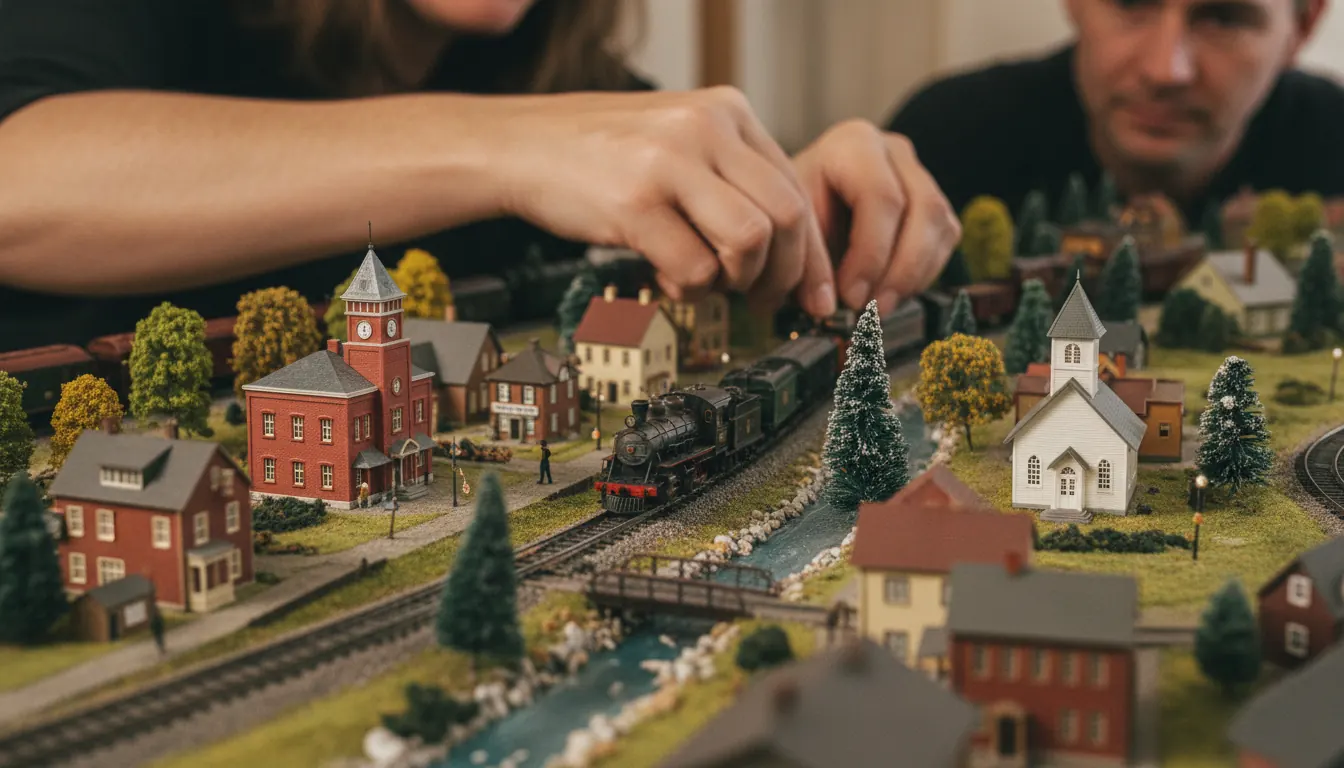
World-building is one of gaming's most powerful draws. The sense that you're inhabiting a place with its own history, logic, and visual language. N scale model railroading offers the same experience, but built entirely by hand. Every structure you place, every weathering technique you apply, every tree you position on a hillside is an act of authorship. The result is a world that belongs entirely to its creator.
This creative ownership feels different from passive entertainment. You're not consuming a world someone else built — you're the architect, art director, and sometimes the historian all at once.
Era, Region, and Story
Experienced N scale modelers often build with a specific era and region in mind — perhaps a northeastern shortline in the 1950s, or a southwestern Class I railroad during the transition to diesel power. This narrative framing gives cohesion to every creative decision. It's not unlike the lore-building that happens in open-world games, where the environment communicates history without stating it directly.
Elements That Create Immersive Layouts
The details that transform a good layout into a truly immersive one go well beyond track and trains. Modelers working toward that level of realism typically focus on:
- Realistic ground cover using fine turf, static grass, and hand-laid ballast
- Weathered rolling stock and structures for temporal authenticity
- Consistent lighting schemes, including interior building illumination
- Sound systems integrated with DCC (Digital Command Control)
- Water features created with resin or specialty modeling mediums
- Figures and vehicles placed with behavioral logic, not just decoration
- Era-appropriate signage, infrastructure, and trackside details
Each of these elements contributes to the sense that the layout is a real place, briefly observed rather than constructed. That distinction — between something that looks built and something that feels found — is the goal every serious modeler works toward.
From Beginners Guide to N Scale Model Railroading to Advanced Layout Design
Every experienced modeler started somewhere modest — a starter set on a hollow-core door, a simple oval with a passing siding, a handful of structures from a beginner kit. The beginners guide to n scale model railroading is really just that first layout, imperfect and educational in equal parts. What matters is that it teaches the fundamentals: track geometry, basic wiring, scenery layering, and the importance of a stable benchwork foundation.
The leap from beginner to intermediate isn't about spending more — it's about understanding more. Layouts grow in complexity when their builders grow in knowledge.
Progression Path in N Scale Modeling
Progress through the stages of the hobby rarely follows a straight line. Most modelers revisit earlier skills with each new layout, building the same foundation with more refined technique each time. The table below offers a general roadmap:
| Stage | Focus Areas | Typical Layout Size | Key Skills Developed |
|---|---|---|---|
| Beginner | Track-laying, basic scenery | 2×4 ft to 4×8 ft | Geometry, patience, planning |
| Intermediate | DCC, operations, structures | 4×8 ft to larger | Wiring, scenery depth, realism |
| Advanced | Full operations, era accuracy | Custom/room-sized | Research, fabrication, design |
| Expert | Prototype modeling, scratch-building | Any | Historical accuracy, engineering |
What Advanced Layouts Teach About Design Thinking
There's a point in every serious modeler's journey where the hobby starts teaching design thinking in a formal sense. Sight lines, negative space, visual hierarchy — the same principles that guide graphic designers and game environment artists apply directly to layout composition. This crossover is part of why N scale attracts people with creative backgrounds, and why creatively inclined gamers often find the transition into modeling surprisingly natural.
Community, Technology, and Long-Term Engagement
No hobby survives on solitude alone. N scale has a thriving global community — active forums, regional clubs, YouTube channels dedicated to specific techniques, and annual conventions where layouts are displayed and evaluated. For people accustomed to gaming communities built around shared enthusiasm and collective knowledge, the railroading community feels immediately familiar. The culture of sharing progress, asking questions, and celebrating others' work carries over almost intact.
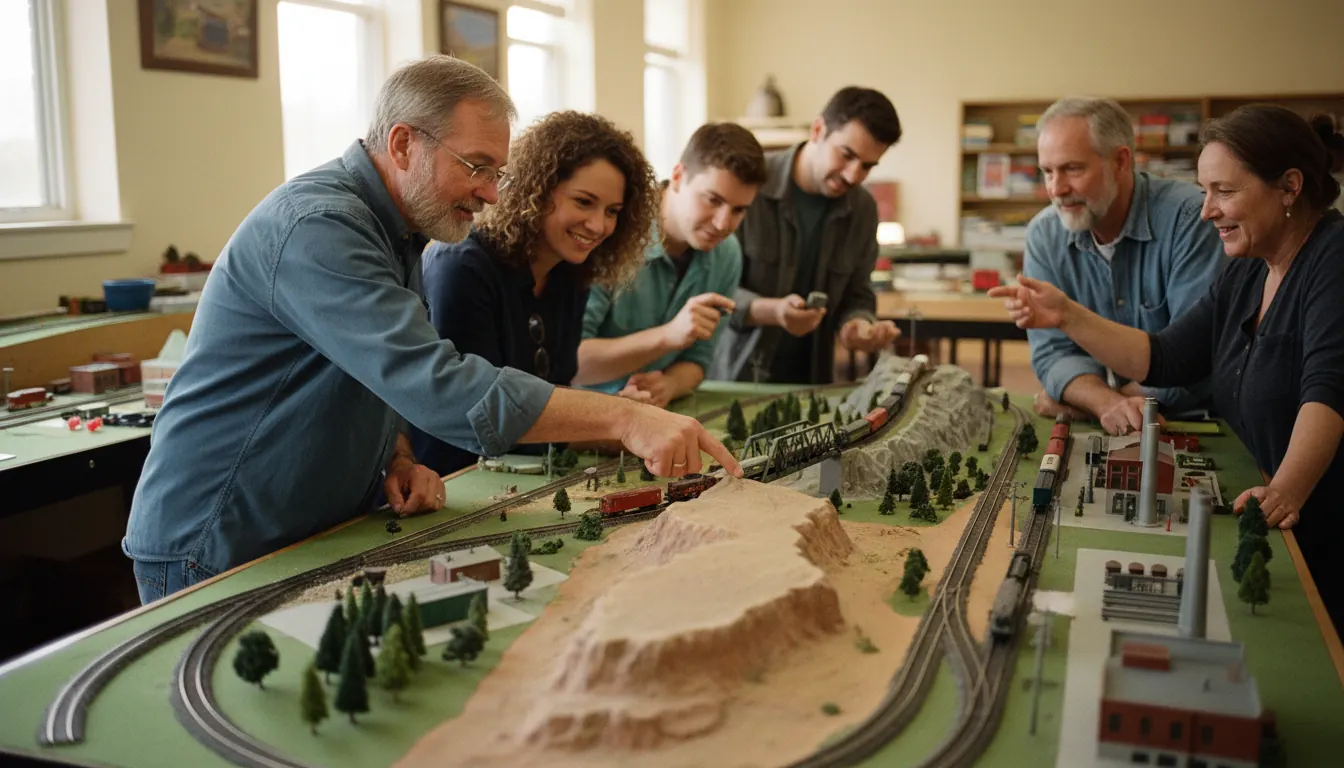
Technology has also transformed what's possible in the hobby. DCC systems now allow multiple locomotives to run independently on the same track with individual sound and speed control. Layout control software lets modelers operate their railroads from tablets. LED lighting has revolutionized interior illumination at very low cost. These technological layers give N scale an ongoing sense of forward momentum — there's always something new to integrate or learn, which keeps long-term engagement high.
"The best layouts I've seen don't just look realistic — they guide your eye. There's intentionality in every inch. That's not an accident; that's design."
— Contributor to a regional N scale modeler's newsletter
The combination of community warmth and technological evolution makes N scale model railroading a hobby that genuinely grows with you. It rewards years of investment without ever feeling exhausted — much like the games that keep players returning not out of habit, but out of genuine ongoing interest.
The parallel between N scale model railroading and gaming culture isn't a coincidence — it reflects something genuine about the minds these hobbies attract. Both demand systemic thinking, reward creative investment, and offer communities built on shared passion. Whether you're deep into layout planning or just starting a beginners guide to n scale model railroading, the mindset that drives you is the same one that makes complex games worth playing.